Bulk supply · Africa
Rivets
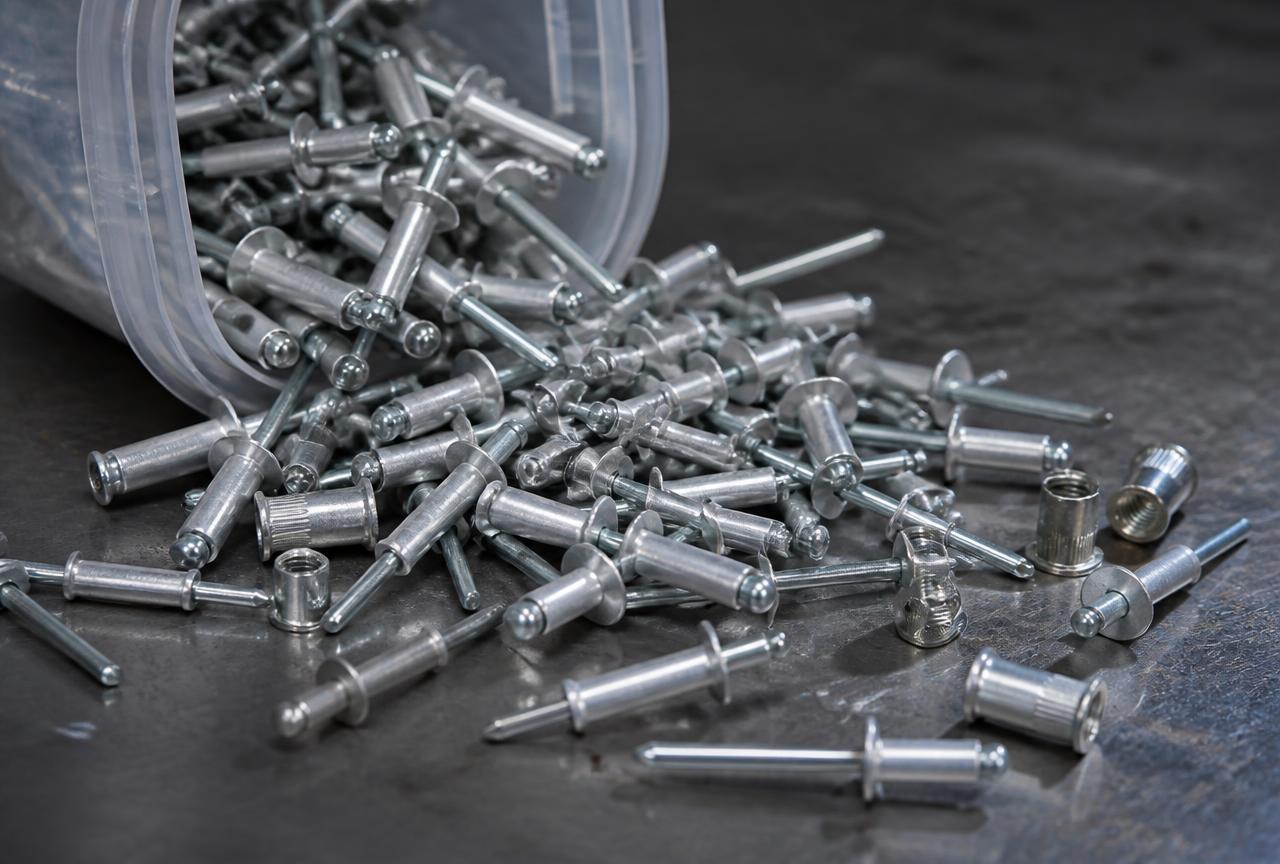
Blind pop rivets, structural rivets and rivet nuts in aluminium, steel and stainless, supplied in bulk for panel, ducting, transport and light fabrication work in Africa.
- OPEN AND CLOSED END
- ALUMINIUM / STEEL / STAINLESS
- RIVET NUTS AND TOOLING
Also searched as: pop rivets · blind rivets · rivet nuts · nutserts · structural rivets
What buyers need to know
Specifying rivets.
Rivets are single-sided fixings: you set them from the face and never touch the back of the joint. That makes them the default for ducting, panelling, signage, truck and bus bodies, shipping container repair and light sheet fabrication, all high-volume users in African manufacturing.
Grip range is the number that gets specified wrong. A rivet has a working thickness window — set it below the range and the joint stays loose, above it and the mandrel breaks before the tail forms. Give us the combined material thickness and we quote the correct body length rather than the nearest one in stock.
Material pairing matters as much as size. Aluminium body with a steel mandrel is the cheap general option; all-aluminium avoids the rust dot the steel mandrel leaves in exposed work; stainless body and mandrel is for coastal and food-grade equipment. Closed-end rivets seal against moisture ingress. Rivet nuts add a reusable thread to thin sheet where a nut cannot be reached, and we supply the setting tools alongside the fasteners.
Specification
Full specification table.
| Types | Open end, closed (sealed) end, multi-grip, large flange, structural, peel |
|---|---|
| Materials | Aluminium/steel, all aluminium, steel/steel, stainless 304 and 316 |
| Diameters | 3.2 mm, 4.0 mm, 4.8 mm, 6.4 mm |
| Grip ranges | 1 mm to 20 mm depending on body length |
| Rivet nuts | M3 to M12, flat head, countersunk, knurled and hex body |
| Tooling | Hand, lazy-tong, pneumatic and battery riveters, plus spare nose pieces |
| Packing | 500 and 1000-piece boxes, bulk cartons and drums |
| Documentation | Shear and tensile values per size on request |
Types we stock and source
Variants on one enquiry.
Open-end blind rivets
General purpose, highest volume, lowest cost.
Closed-end rivets
Sealed body keeps water and dust out of the joint.
Multi-grip rivets
One rivet covers a wide thickness range, cuts stock lines.
Large flange rivets
Wide head spreads load in soft or thin sheet.
Structural rivets
Locked mandrel and high shear for load-bearing joints.
Rivet nuts (nutserts)
Reusable internal thread set into thin sheet.
Coating by exposure
Which finish for which African site.
- Internal panelling
- Aluminium body with steel mandrel is fine.
- Exposed and painted
- All-aluminium or stainless mandrel to avoid rust staining.
- Coastal / marine
- Stainless 316 body and mandrel throughout.
- Dissimilar metals
- Match the rivet to the softer panel to avoid galvanic attack.
Typical order sizes
What a real enquiry looks like.
- 200,000 4.8 mm aluminium rivets for a ducting manufacturer
- Stainless closed-end rivets for coastal signage and enclosures
- Rivet nut package with two pneumatic setting tools for a bus body shop
Questions
Rivets FAQs.
- How do I choose rivet grip range?
- Add the thickness of every layer being joined and pick a rivet whose published grip range brackets that number, ideally near the middle. Multi-grip rivets cover a wide window and let you carry fewer lines in stock.
- What is the difference between an open and closed-end rivet?
- An open-end rivet has a hollow body that stays open after setting; a closed-end rivet is sealed at the tail, which stops moisture and dust passing through the joint. Closed-end costs more and is worth it on exposed or weathertight work.
- Do you supply riveting tools as well?
- Yes. Hand, lazy-tong, pneumatic and battery riveters plus nose pieces and rivet nut setting tools are quoted on the same enquiry as the fasteners.
Where we ship it
Rivets by country.
“Africa buys fasteners on .net”